

Does the Bible Teach Flat Earth? The Verses in Context
The real question is simple: do the Bible's words support flat earth, or are those verses being pulled out of context?
If you slow down and read the Hebrew, the Greek, the genre, and the setting, the answer gets much clearer. Many flat earth proof texts are poems, idioms, or apocalyptic symbols. They are not giving a blueprint of the planet any more than "sunrise" means the sun circles the earth.
So the issue is not whether Scripture is true. It is whether people are reading it the way God gave it.
How to read Bible verses about the earth without forcing modern flat earth ideas into them
Faithful Bible reading starts with authorial intent. What did Isaiah mean to his audience? What did John mean in Revelation? If a poem uses imagery, you read it as imagery. If a dream uses symbols, you do not turn those symbols into engineering diagrams.
That matters here because flat earth teachers often mix genres. They take a Psalm, a prophecy, and a vision, then flatten them into one literal cosmology. That is not careful exegesis. It is proof-texting.
The Bible speaks truly, but it does not always speak in technical, scientific terms.
Poetry, idioms, and visions are not the same as science language
Psalms and Job are full of pictures. Isaiah often uses elevated poetry. Revelation is apocalyptic, which means it is packed with symbols. When Scripture says "ends of the earth" or "pillars of the earth," it often speaks the same way we still do. People say "the sun rose" every day, and nobody thinks they are rejecting astronomy.
A short overview at fresh.bible on whether the Bible teaches a flat earth makes the same point well. Human-observer language is normal language.
Why original Hebrew and Greek words matter in this debate
A lot of the flat earth argument hangs on English words alone. That is risky. Hebrew and Greek terms often have a range of meanings, and context decides which sense fits.
For example, chug can mean circle or horizon, raqia means expanse, qatsah means end or extremity, kanaph can mean wing or edge, ammud means pillar, and gonia means corner or angle. None of those words, by themselves, prove a disk-shaped earth with a dome over it.
Every major Bible verse Flat Earthers use, explained in its real context
Most flat earth readings break down for one reason. They take imagery meant to show God's power and turn it into physical measurements.
Isaiah 40:22, the circle of the earth does not mean a flat disk
Isaiah 40:22 says God sits above the "circle" of the earth. The Hebrew word is chug. It can refer to a circle, a vault, or the horizon. Flat earth readers say "circle" must mean a flat coin. That does not follow. A globe also appears circular from every viewpoint.
More important, Isaiah's point is theological. God is high above the nations, rulers, and idols. The verse also says He stretches out the heavens "like a curtain" and spreads them "like a tent." Nobody reads that as fabric sewn over the sky. The language is visual and majestic.
Scholars debate how far chug can be pressed, and Robert Schneider's study of Isaiah 40:22 and Job 26:7 is useful here. Still, even the cautious view does not support flat earth.
Genesis 1 and the firmament verses do not teach a hard dome over a flat world
Genesis 1:6 to 8 uses the word raqia. Older English versions say "firmament," which makes many readers picture a hard shell. But raqia comes from a verb meaning something spread out. So expanse is a better rendering in context.
Job 37:18 is often paired with this: "hard as a molten mirror." Yet Job is poetry, and that line is a simile. It describes the sky as it appears from below, bright and solid-looking. It is not a lab report.
If you want a broader word-study approach to Genesis language, this Genesis 1:2 Hebrew study gives added context. The key point remains simple: appearance language does not create a flat-earth system.
Job, Psalms, and Samuel use foundations and pillars as word pictures for stability
Flat earth teachers often cite Job 38:4 to 6, Job 9:6, Psalm 75:3, Psalm 104:5, and 1 Samuel 2:8. These passages mention foundations, bases, and pillars. The Hebrew word ammud means pillar. In poetry, pillars picture support and order.
That is the point. God made a stable world. The writers are not describing giant columns under the crust.
Job itself gives a balancing text: Job 26:7 says God "hangs the earth on nothing." If you read pillars literally, you create tension inside the same book. The better reading is metaphor in one place, striking description in another.
This same mistake has shown up before. Through history, some readers turned poetic lines into false claims about nature. Yet mainstream Jewish and Christian interpretation never built a settled flat earth doctrine from these verses.
Four corners, ends of the earth, and the earth not being moved are common figures of speech
Revelation 7:1 and 20:8 mention the "four corners" of the earth. The Greek word is gonia, corner or angle. Isaiah 11:12 uses the Hebrew kanaph, literally wing, often meaning edge or extremity. Ezekiel 7:2 uses qatsah, meaning end or far boundary. These are ordinary ways to speak about the whole world and the four directions.
The same goes for "ends of the earth." People still say "the ends of the earth" to mean distant lands. Nobody means the planet has literal edges.
Psalm 93:1, Psalm 96:10, and 1 Chronicles 16:30 say the world "shall not be moved." The Hebrew idea is stability, from a verb meaning to totter or shake. The message is that God's created order is secure. It is not a claim that earth sits motionless in space.
Daniel 4 also gets misused. Nebuchadnezzar's tree is visible to "the end of all the earth." But Daniel 4 is a dream. Dreams are full of symbols. The same applies to Matthew 4:8, where Jesus is shown the kingdoms of the world. The text does not require a literal mountain with a flat-earth sightline.
What Scripture says that fits a round earth better than a flat earth
The Bible is not a science manual. Still, its language fits a globe better than a flat-earth map does.
Job 26:7, Job 26:10, Proverbs 8:27, and Isaiah 40:22 point to a curved world, not a flat one
Job 26:7 is a major problem for flat earth. God "hangs the earth on nothing." That is not how flat earth models speak. They need supports, pillars, or a base. Job says the opposite.
Job 26:10 and Proverbs 8:27 speak of a chug, a circle or boundary, on the face of the waters. That sounds like the horizon line, the curved boundary where sky and sea meet from human sight. Isaiah 40:22 fits that same kind of imagery.
None of this forces modern astronomy into the text. Still, these verses do not help flat earth. They fit naturally with a world that is rounded and suspended.
The Bible’s world language makes sense on a globe
Scripture often speaks of distant nations, far coasts, and the whole inhabited world. It speaks from human perspective, and that works fine on a globe. Day and night move across lands. Peoples live far apart. The horizon appears circular. The earth is described as suspended, not resting on a platform.
Outside Scripture, the case is settled. Navigation, circumnavigation, lunar eclipses, satellite imagery, and ordinary astronomy all confirm a round earth. Flat earth collapses under both Biblical context and observable reality.
Where modern flat earth came from, why it spread, and how Bible verses got pulled into it
Modern flat earth is not the historic Christian view. It is a recent fringe movement.
Samuel Rowbotham and the birth of the modern flat earth movement
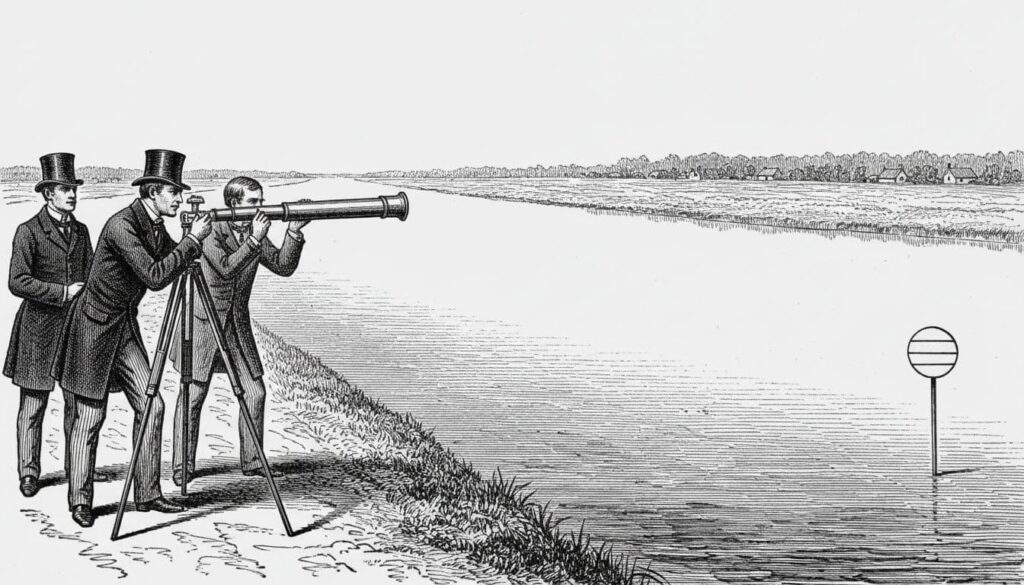
The modern movement traces back to Samuel Rowbotham in 19th-century England. He promoted Zetetic Astronomy, ran the Bedford Level experiment, and later published Earth Not a Globe. His work pushed against the growing scientific consensus, and he wrapped that push in selective Bible reading.
A helpful summary of that revival appears in BBC's report on the Bedford Level story. Later figures, including Lady Elizabeth Blount and Samuel Shenton, kept the idea alive. After 2015, social media gave it a fresh audience.
Why flat earth keeps returning, distrust, conspiracy thinking, and selective Bible reading
Flat earth spreads because it offers secret knowledge, a strong group identity, and a target for distrust. If someone already suspects governments, science, media, and churches, a total conspiracy can feel strangely comforting. It explains everything by rejecting everything.
That also helps explain why Bible verses get misused. Poetry becomes geometry. Visions become maps. Idioms become engineering. A broader overview of modern flat Earth beliefs shows how those themes keep repeating.
The old claim that most Christians once believed in a flat earth is also false. Educated people in the ancient and medieval world often knew the earth was round. The "church taught flat earth" story was largely inflated in the 1800s by conflict narratives that pitted faith against science.
The Bible’s future earth, the new creation, and why flat earth does not fit the full story of Scripture
Isaiah 65:17, Isaiah 66:22, 2 Peter 3:13, and Revelation 21 to 22 point to the new heavens and new earth. The focus is renewal, judgment, resurrection, and God's dwelling with His people. The focus is not planetary geometry.
New heavens and new earth means renewed creation, not proof of a flat world
Revelation is symbolic from start to finish. It gives beasts, lamps, bowls, dragons, and cities with cosmic meaning. So when it speaks of the future earth, you should not force flat-earth ideas into it any more than you would turn the dragon into zoology.
The Bible ends with a renewed creation under Christ's rule. Nations walk in God's light. Evil is judged. Death is defeated. Nothing in that hope supports a disk, an ice wall, or a dome. The prophecy points to redemption, not conspiracy cosmology.
The bottom line is plain. The verses flat earthers use are poetic, idiomatic, symbolic, or lifted out of context. When you respect the original language and the kind of writing in front of you, Scripture does not teach flat earth.
That matters because the Bible does not need a false cosmology to defend its truth. It speaks truthfully when it is read the way God gave it, in context, with care, and with the whole history in view.

