
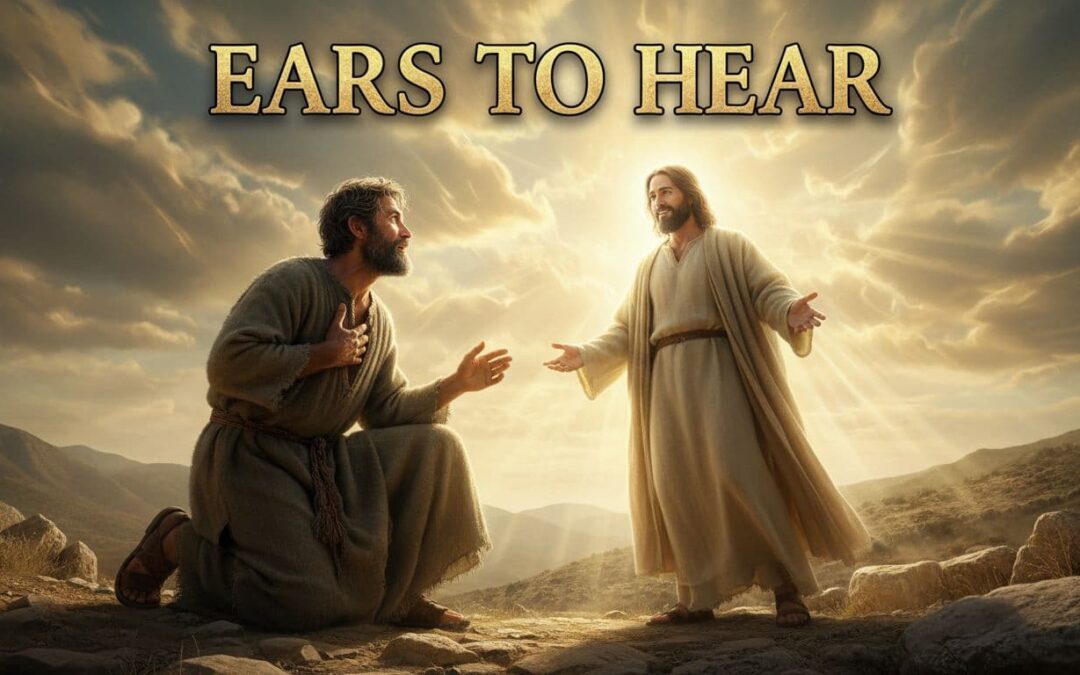

“Whoever Has an Ear to Hear”: How the Holy Spirit Makes Jesus Clear
“Whoever has ears to hear, let him hear.” Jesus said that line so often that it can start to feel like a catchphrase. But He wasn’t talking about better hearing aids or paying closer attention. He was talking about spiritual hearing, the kind that understands what God is saying and actually responds.
A lot of us know what it’s like to feel spiritually “stuck.” You read the Bible, you listen to sermons, you try to pray, but it still feels foggy. This is where Jesus’ words land with hope. An ear to hear isn’t about being the smartest person in the crowd. It’s about God opening the heart.
In this article, we’ll look at (1) what “ears to hear” means in the original language and setting, (2) what the Bible means by “hear,” (3) how the Holy Spirit brings understanding and reveals Jesus as Messiah, (4) moments when Jesus said who He is but people only “got it” by revelation, and (5) how God works through Spirit-empowered believers, even through small acts of obedience that people don’t always recognize as God’s guidance.

What did Jesus mean by “ear to hear” in the original language and in context?
 Jesus teaching a crowd outdoors, with the parable of the sower pictured in the scene.
In the Gospels, the phrase shows up like this: “The one having ears to hear, let him hear.” It’s a call, not a compliment. Jesus is saying, “If you’re willing, lean in. If you’re teachable, receive this.”
The key word behind “hear” is the Greek verb akouō. It can mean “to hear” with your ears, but it often carries the idea of listening with understanding, even listening in a way that leads to action. If you want to see how the word is used across the New Testament, BibleHub’s entry on akouō is a helpful reference.
Jesus used “ears to hear” in moments where responses were mixed. Some people were curious, some were offended, some were hungry for truth. A big setting for this phrase is Jesus teaching in parables, especially in Matthew 13 and Mark 4. He tells a story, people enjoy the story, but only some receive the meaning.

This fits an Old Testament pattern. Israel’s faith begins with a command: “Hear, O Israel” (Deuteronomy 6:4). In Hebrew thought, “hear” isn’t passive. It’s a summons to receive God’s word as true and live by it. (If you’ve ever wondered why the Bible talks about “ears” and “hearts” like they’re connected, you’re not alone. Cultural idioms matter, and this short article from EnGedi Resource Center is a good window into how Hebrew-style communication shapes Biblical phrases.)
Jesus also links “hearing” to a warning from Isaiah. In Matthew 13:14-15, He quotes Isaiah’s words about people whose hearts grow dull and whose ears can barely hear. That’s not a jab at people who struggle. It’s a diagnosis: you can be physically present and still closed inside.
Why Jesus used parables and then said, “Let him hear”
Parables do two things at once. They reveal truth to humble hearts, and they expose hard hearts. God isn’t being cruel. He’s being honest about what pride does to a person.
Think about the parable of the sower. The seed is the same word, scattered generously. The difference is the soil. Some hearts are packed down, some are shallow, some are crowded with thorns, and some are ready. The story isn’t mainly about farming. It’s about receptivity.
When Jesus says, “Let him hear,” He’s calling people to move from “That was a nice story” to “God is speaking to me, and I need to respond.”
Physical ears vs. spiritual ears: the Bible’s pattern
Plenty of people heard Jesus’ literal voice and still missed Him.
Spiritual deafness can look really normal: distraction, unbelief, fear of change, craving control, or wanting Jesus on our terms. You can attend church, know the vocabulary, and still resist the voice of God when it presses on something you don’t want to surrender.
The good news is that Jesus’ warning is also an invitation. If dullness can happen, softness can happen too. God can wake up the heart.
Biblical “hearing” means understanding and responding, not just listening
In the Bible, “hearing” is whole-person language. It includes:
- Listening (you receive the message)
- Understanding (it makes sense, it connects)
- Believing (you accept it as true)
- Responding (you act on it)
That’s why Romans 10:17 says faith comes by hearing, and hearing through the word of Christ. And it’s why James 1:22 warns us not to be hearers only, but doers. Biblical hearing changes what you do next.
Did you hear that? Faith comes by hearing. I remember when I first started hearing God’s voice, it was almost immediately after I became born again. It was nothing dramatic, it was God telling me to check my schedule at work. Some people think God is too busy for that, but those are the people you have to wonder how hard they try to hear from God themselves, if at all.
God is never too busy to talk with us. That has been His goal in creation all along. Adam and Eve knew God, as clear we know the people in our lives. They did not have to wonder if God is real or not, He was right there when Adam opened his eyes and when Eve opened her eyes also.
Their faith in God was already set in motion, but their trust in Him was far from perfect. God told them they could eat from any tree except one. He told them what would happen if they ate from that tree, but they did it anyway. Why?
They ate from the tree because Eve heard what the serpent (Satan) said and she responded to what she heard. Adam did that same thing with Eve, he listened to what she said and he responded to what he heard. Neither one of them responded to what God Himself already said about the tree. In the moment, their faith was in what they heard apart from God and how it confirmed their feelings and their desires to follow their own heart.
That is why James warns not to be hearers only, but doers, because what we do is a direct response to where our faith is at in the moment we do anything. Our faith should be in God at all times and what He has said. This is when sin enters in, when we put our faith in anything else above God.
God will never tell us to do anything that goes against the Bible because He wrote the Bible. It is the Word of God, written by Jesus as the Word of God through humans on earth by the power of the Holy Spirit.
We put our faith in things other than God all the time. This is how we get our lives messed up. That is the reason Jesus came to redeem us from sin, and is why every Christian needs to know the Bible. So many times we do things that go against God, but we don’t realize it because we are ignorant of what He has said. Many Christians are walking around with unrepentant sin because they don’t know they are sinning.
Sometimes the response to God is obvious, like repentance. Sometimes it’s quiet, like forgiving someone, telling the truth, asking for prayer, or opening the Bible again after you wanted to give up.
Hearing that produces faith: how the Word and faith connect
Romans 10:17 is simple but deep. God uses the message about Christ to awaken faith in the heart. Faith doesn’t come from personality or hype. It comes when God’s truth (the Holy Spirit) gets inside a person and the person becomes born again, then the person hears God’s voice and responds.
That also explains something many people have experienced: you can be around Scripture a lot and still not truly “hear” it. Familiarity isn’t the same as surrender. A person can quote verses and still resist the Holy Spirit, just like those who stoned Stephen.
An ear to hear is when the Word stops being background noise and starts being personal.
Hearing that produces obedience: why response matters
James says if we only listen and never respond, we deceive ourselves. That’s sharp, but it’s also merciful. God doesn’t want to leave us in a pretend faith.
Small obedience is a big deal in the Kingdom of God. Examples that fit everyday life:
- Confessing sin to God instead of hiding it
- Making peace with someone you’ve avoided
- Praying for a friend when you feel nervous
- Turning away from a habit that’s dragging you down
- Taking one step you know is right, even if you don’t feel strong
This is where Jesus’ phrase becomes practical. An ear to hear is a heart that says, “Lord, I’ll do the next right thing.”
How the Holy Spirit gives an “ear to hear” and reveals Jesus as the Messiah
 Peter confessing Jesus with a sense of divine revelation.
Here’s the turning point: Scripture teaches that real understanding of Jesus is not just a human “aha moment.” It’s revelation.
1 Corinthians 2 explains that God’s wisdom can’t be fully grasped by “natural” thinking alone. Spiritual truth is spiritually discerned. That doesn’t mean Christians stop using their minds. It means the mind needs light.
Jesus promised this kind of help. In John 14:26, He says the Holy Spirit will teach and remind His followers of what He said. In John 16:13, He says the Spirit will guide them into truth. The Spirit doesn’t invent a new Jesus. He makes the real Jesus clear.
If you want a simple overview of the Spirit’s identity and work, this internal resource on Who is the Holy Spirit explained lays a strong foundation.
“Flesh and blood didn’t reveal this”: Peter’s confession and divine revelation
Matthew 16:13-17 is one of the clearest moments in the Gospels.
Jesus asks His disciples who people say He is. Answers fly around. Then Jesus makes it personal: “Who do you say that I am?” Peter responds, “You are the Christ, the Son of the living God.”
Jesus doesn’t say, “Good job, Peter. You’re observant.” He says, “Flesh and blood didn’t reveal this to you, but my Father who is in Heaven.”
Evidence mattered. Peter had watched Jesus teach and heal. But revelation was the moment it moved from information to conviction. That’s what an ear to hear looks like when it clicks.
The Spirit’s job is to spotlight Jesus, not Himself
Jesus is clear about the Spirit’s mission. The Holy Spirit teaches, reminds, guides, and points. He brings Jesus into focus.
That’s why “revelation” in a Biblical sense doesn’t need to be weird or secret. It can be as plain as this: a person reads a Gospel history they’ve heard before, and suddenly they see Jesus as Lord, not just a historical figure.
When Jesus said He is the Messiah, why some still missed it until revelation came
Jesus didn’t hide His identity all the time. He said it in different ways, in different settings. Still, many people stayed stuck until God opened their understanding.
The pattern often looks like this: Jesus speaks truth, the Spirit makes it land, then the person responds.
The Samaritan woman: “I who speak to you am He” and a town begins to believe
 Jesus speaking with the Samaritan woman at Jacob’s well.
In John 4, Jesus meets a Samaritan woman at Jacob’s well. The conversation starts ordinary (water, thirst), then turns spiritual fast. Jesus exposes details about her life that He shouldn’t know. Then she brings up the coming Messiah.
Jesus replies plainly: “I who speak to you am He.”
That’s direct. And her response is wild in the best way. She goes back to town and starts telling people. She doesn’t have a full theology degree. She has a real encounter and a changed direction.
For deeper reading on the story’s flow and meaning, JesusWalk’s study on John 4 walks through the passage clearly.
This is also a picture of how God uses people right away. Her understanding was still growing, but her obedience was immediate.
Martha at the tomb: seeing the Messiah through grief
In John 11, Lazarus dies. Martha meets Jesus in the middle of pain, confusion, and disappointment. Jesus says, “I am the resurrection and the life.” Then He asks her if she believes.
Martha answers with a confession: she believes He is the Christ, the Son of God.
Notice the setting. This isn’t a calm Bible study night. It’s grief. And yet, this is where revelation and trust show up. An ear to hear is not only for quiet mornings and peaceful emotions. God can open the heart in sorrow, too.
Why miracles and arguments are not enough without the Spirit
Miracles can grab attention. Good answers can remove obstacles. Clear preaching can explain the message. But only God changes the heart.
That’s basically 1 Corinthians 2 again. Without the Holy Spirit’s work, a person can label Jesus “interesting” but never bow to Him as Lord. That’s why Christians can speak truth boldly without panic. We don’t have to force outcomes.
How God uses Spirit-filled people to help others realize Jesus is the Messiah

God’s normal way of reaching people is sending people. He fills believers with the Holy Spirit, and then He puts them in places where conversations and choices matter.
Sometimes it’s preaching. Often it’s quieter than that: friendship, prayer, Scripture shared at the right time, a testimony that’s honest, love that doesn’t quit.
The Holy Spirit supplies power and clarity. We supply willingness.
For readers curious about the Spirit’s empowering work in the early church, this internal article on the meaning of tongues of fire in Acts 2 connects Pentecost to Spirit-empowered witness.
God’s pattern: the Spirit empowers, people speak, hearts open
Here’s a simple pattern you can remember:
- God prompts (a nudge to speak, pray, or act).
- A believer responds (even if nervous).
- The message about Jesus is shared (who He is, what He did).
- The Spirit brings conviction and clarity (the listener begins to “hear”).
- The listener responds (faith, repentance, questions, surrender).
Romans 10:17 sits right in the middle of this. People come to faith as they truly “hear” the word of Christ, and God often delivers that message through human mouths.
Faith in action: responding to God even when you don’t realize it
This matters for everyday Christians who don’t feel “special.”
Faith often looks like small yeses: starting a conversation you didn’t plan, offering to pray for someone, sharing one verse, inviting someone to church, choosing kindness when you had every excuse not to.
And sometimes, a person is doing what God wanted without realizing it. They think, “I’m just trying to be a decent human,” but God is guiding their steps toward a moment that helps someone else see Jesus.
That doesn’t mean every impulse is God. A good safeguard is simple: it has to match Scripture, and it helps to seek wise counsel when something feels weighty.
In the same manner, we often get insight whispered into our ears by demons. Many people do not know how to discern the differences between God, demons, and our selves giving us thoughts. The simple solution is to not act impulsively on our thoughts. Give yourself time to digest what you hear.
Even Peter, right after his great Revelation from the Father about Jesus being the Messiah, listens to a demon whisper in his ear and Jesus has to rebuke him. (Matthew 16:21-23)
But don’t miss the comfort here: living in God’s will often looks normal. It’s doing the good you know to do, with a heart that’s available to God.
Conclusion: Ask for an ear to hear, then take the next step
An ear to hear is spiritual readiness, not sharp natural talent. Biblical hearing includes response, not just listening. The Holy Spirit is the One who opens understanding and makes Jesus personal and clear. People often missed what Jesus said about Himself until God brought revelation. And God still uses ordinary believers who say yes, even in small ways, to help others recognize Jesus is the Messiah.
A simple prayer you can pray today: “Holy Spirit, give me an ear to hear. Show me Jesus clearly, and give me courage to respond.”
Then take one action step: read a short Gospel passage (like John 4 or Matthew 16) and pray, “Holy Spirit, show me Jesus, and help me obey what I hear.”
When you know Jesus, you won’t have a problem obeying. It is not about a set of rules you follow because you are religious. It is about a God you love with all your heart so you obey Him naturally, without any other reason other than you simply love God.
