
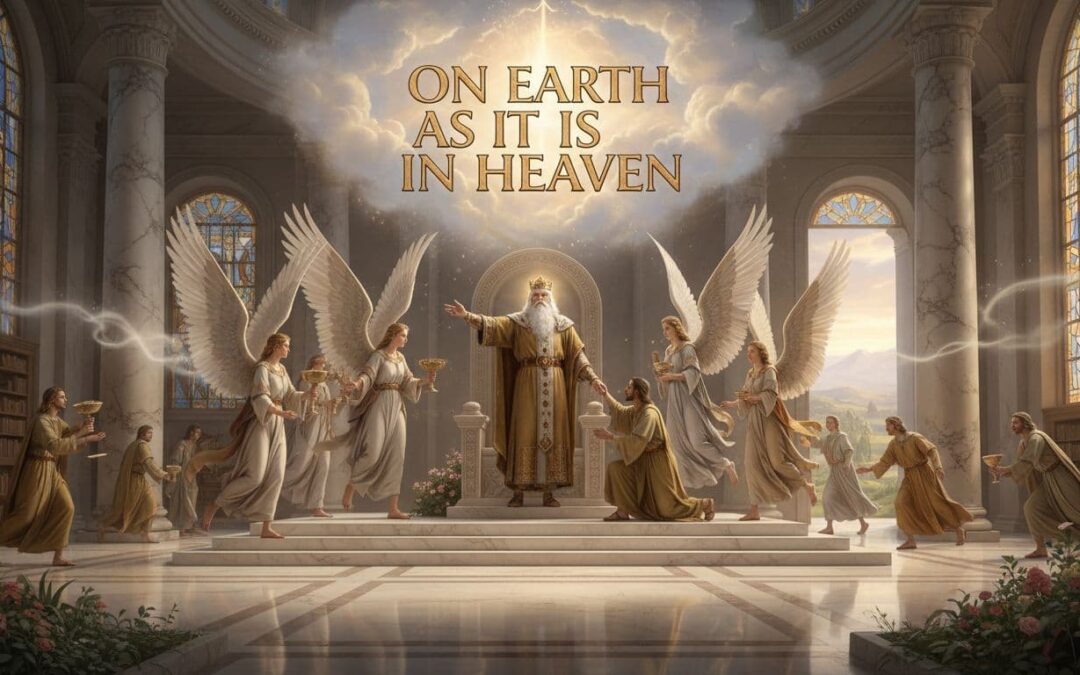

Psalm 103:20, Angels, and God’s Will (How Heaven Obeys, and Why We Must Choose)
What does it mean that angels “do His word, heeding the voice of His word” (Psalm 103:20)? At first glance it sounds poetic, but it’s also a straight-up description of how Heaven works. No delay, no debate, no half-obedience. Just action.
And once you see that, Jesus’ prayer in Matthew 6:10 starts to hit different: “Your will be done on earth as it is in heaven.” Heaven already runs on God’s will. Earth doesn’t. Earth is where we choose.
This matters because Jesus also warned about “that day” (Matthew 7:21-23), the day when claims and religious activity won’t save anyone, only a real relationship shown by doing God’s will. Let’s walk through (1) the Hebrew and context of Psalm 103:20, (2) how “His word” fits Jesus as the eternal Word before the incarnation, (3) where Scripture shows Jesus commanding angels, (4) why Heaven obeys instantly but earth must decide, and (5) how the Holy Spirit brings the Kingdom of God through obedient people.

Psalm 103:20 in Hebrew: what “do His word” really means
Psalm 103 is a rising song of praise that starts personal (“Bless the LORD, O my soul”) and then zooms out until it includes everything God made. The order matters: God is on the throne, then angels, then all His works.

Psalm 103:19 sets the frame: “The LORD has established His throne in the heavens, and His Kingdom rules over all.” Then verse 20 calls on the angels, the first responders of Heaven, to bless Him.
Here’s Psalm 103:20 in Hebrew:
בָּרֲכוּ יְהוָה מַלְאָכָיו גִּבֹּרֵי כֹחַ עֹשֵׂי דְבָרוֹ לִשְׁמֹעַ בְּקוֹל דְּבָרוֹ
Transliteration: Barakhu YHWH mal’akhav, giborei koach, osei devaro, lishmoa bekol devaro.
Plain-English paraphrase: “Bless the LORD, you angels of His, mighty in strength, who carry out what He says, who listen in order to obey the sound of what He speaks.”
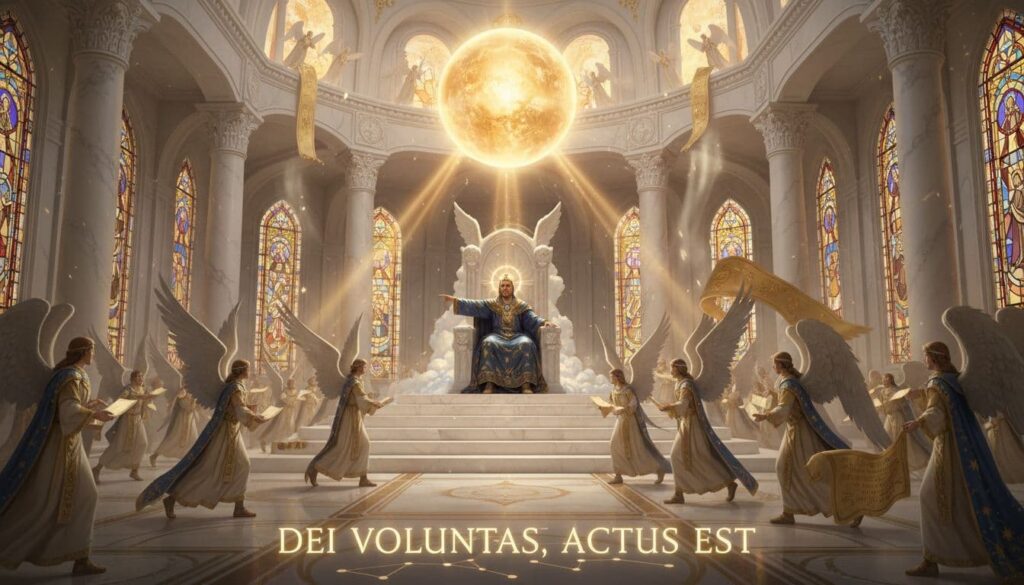
Two phrases carry the punch: “do His word” and “heeding the voice of His word.” This isn’t about angels admiring God’s ideas. It’s about angels acting out God’s commands as soon as they hear them.
For a helpful overview of Psalm 103’s flow (and how the praise expands from Heaven to all creation), see Enduring Word’s Psalm 103 commentary.
“Doers of His word”: angels as active servants, not just listeners
The phrase “do His word” is עֹשֵׂי דְבָרוֹ (osei devaro). Osei comes from a verb meaning “to do” or “to make.” It paints angels as active agents, not passive listeners.
And the word for “word” here is דָּבָר (dabar). In the Old Testament, dabar often means a spoken word, a decree, a command, or a message. Not a “verse on a page,” but the king’s order.
Picture a throne room: the King speaks, the servants move. That’s the feel. Angels exist in a world where God’s will isn’t a theory, it’s a command that gets carried out.
“Heeding the voice of His word”: hearing that equals obeying
The next phrase is לִשְׁמֹעַ בְּקוֹל דְּבָרוֹ (lishmoa bekol devaro), “to hear the voice of His word.”
The verb shama (here, lishmoa) is famous in the Bible because “hear” often includes “obey.” That’s why Israel’s central confession begins, “Hear, O Israel” (the Shema, Deuteronomy 6:4). In Hebrew thinking, real hearing shows up as response, as explained in our article here:
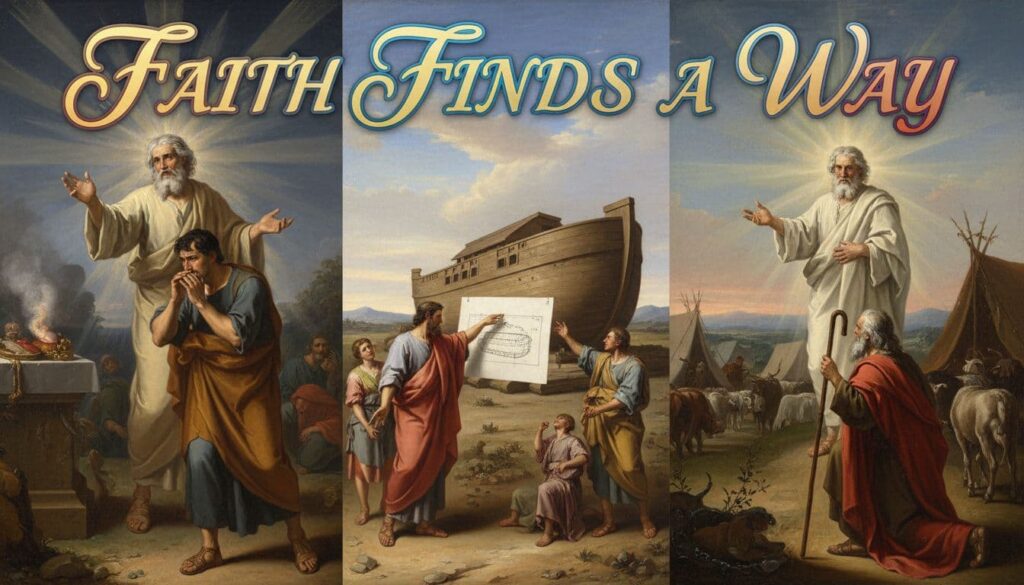
So Psalm 103:20 gives a clean picture of Heaven’s normal life: angels hear God speak, and they do God’s will right away. No bargaining, no postponing, no “I’ll do it when it works for me.”
That’s the heartbeat behind Jesus’ words in Matthew 6:10, and we’ll connect those dots soon.
How Psalm 103:20 points to Jesus as the eternal Word commanding Heaven’s armies
Psalm 103 itself doesn’t say “Jesus” by name. But it does show the mechanism of Heavenly rule: God reigns from His throne (v. 19), and angels respond to His spoken command (v. 20). When the New Testament opens up who God’s Word is, it becomes hard not to see Jesus right in the middle of that throne-room reality.
The key is that “before He had a body” means before the incarnation, before the Son (Jesus) took on human flesh. The Son did not begin at Bethlehem. He entered humanity there.
Jesus before the incarnation: the Word who speaks with God’s authority
John 1:1-3 says the Word was with God, the Word was God, and all things were made through Him. Then John 1:14 says the Word “became flesh.” That’s the incarnation in plain terms, when the Holy Spirit put the Word of God (Jesus) in the virgin Mary, and Jesus became 100% human as well as He stayed 100% God like He always was and is to come.
So when Psalm 103 shows angels obeying God’s spoken word, the New Testament reveals that God’s Word is not just a sound, it is personal. The Son is the eternal Word, fully God, not a created messenger, like many false religions teach.
This doesn’t mean Psalm 103:20 is “only about Jesus.” It means Psalm 103:20 fits perfectly with the full Bible history: God rules, and His rule goes out through His Word, the Son Jesus.
If you want a simple explanation of Psalm 103:20’s meaning in context, BibleRef’s note on Psalm 103:20 is a useful starting point.
Angels under Jesus: they worship Him and move at His command
Hebrews 1 is blunt about rank and authority. Hebrews 1:6 says angels worship the Son. Hebrews 1:7 describes angels as servants, even “winds” and “flames” in God’s service. The Son is not part of the angelic class like some false religions will have people believe.
Then Jesus says something wild in Matthew 26:53, right as He’s being arrested: He could call on the Father, and the Father would send more than twelve legions of angels. That’s not Jesus speaking like a fellow worker. That’s authority.
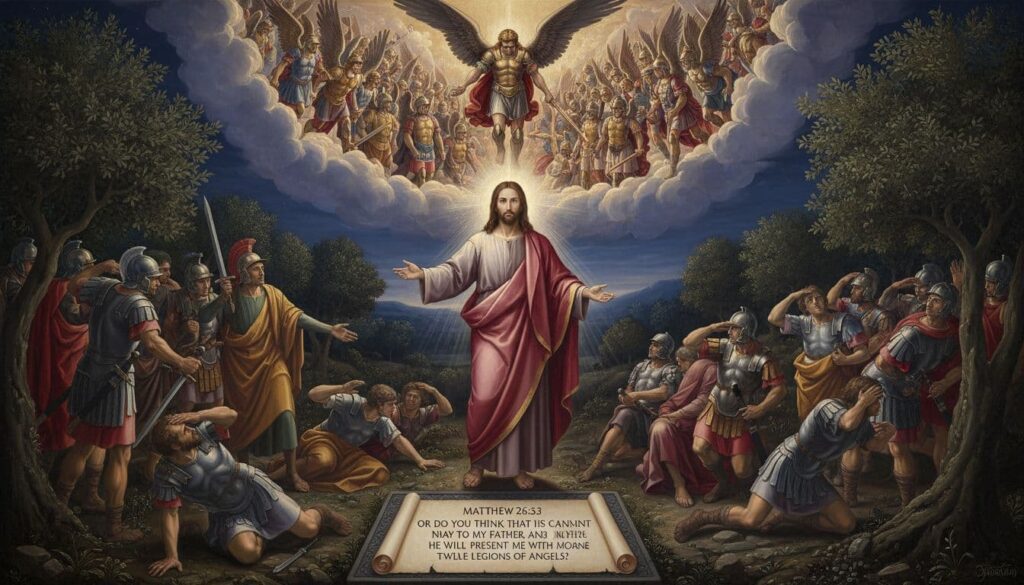
For a verse-focused explainer, see BibleRef’s note on Matthew 26:53. The point is simple: angels do God’s will, and Jesus speaks as One who can summon Heaven’s armies without panic.
Many Bible moments where Jesus commands angel armies (and why it matters)
Once you start looking, Scripture is full of scenes where Heaven’s forces act in perfect coordination with God’s command. Some texts are direct: “The Son of Man will send His angels…” Other texts are more mysterious, especially “the Angel of the LORD” passages.
Quick caution (because this matters): many Christians see “the Angel of the LORD” as appearances of the pre-incarnate Christ, because the figure speaks as God, receives worship, and carries divine authority. Not everyone explains it the same way. But for our purpose, the main point stands either way: Heaven’s messengers move under God’s authority, and the Son shares that authority.
If you want background on this “Angel of the LORD” discussion, Got Questions has a summary.
OT snapshots: the Commander of the LORD’s army and the Angel of the LORD
In Joshua 5:13-15, Joshua meets the “Commander of the army of the LORD.” Joshua falls down, and the commander tells him to remove his sandals because the ground is holy. That’s the same “holy ground” theme from Moses’ call.
In Exodus 3:2-6, the Angel of the LORD appears in the burning bush, and then the voice says, “I am the God of your father.” Moses hides his face because he’s afraid to look at God. The presence is not casual.
In Judges 13:18-22, Manoah asks the Angel’s name, and the answer connects to “wonderful.” Manoah fears they will die because they have seen God.
In Judges 13:18, Manoah asks the Messenger’s name, and the reply is sharp, “Why do you ask my name, seeing it is wonderful?” The key word behind “wonderful” is the Hebrew pil’i (פִּלְאִי), from the root pala (פלא), which points to something extraordinary, beyond grasp, even kind of “too amazing to pin down.” It’s not just “cool” or “impressive,” it’s the kind of wonder that makes you back up because you’re dealing with God’s own category of greatness.
That fits the story’s vibe, because this isn’t presented as a random angel with a business card, it’s the LORD’s messenger who receives worship-like honor and then goes up in the flame of the altar (and Manoah realizes they’ve encountered God). So when the Messenger says His name is “wonderful,” He’s basically saying, “You don’t get to box this in, you’re asking for something you can’t contain.” The Greek Old Testament uses a word like thaumaston (θαυμαστόν), which carries the same idea of awe and mystery, not a simple label.
Now jump to Isaiah 9:6, where the promised royal Child is called “Wonderful Counselor,” and in Hebrew that starts with pele (פֶּלֶא), the same word family as Judges 13. Isaiah’s point isn’t that the Messiah gives nice advice, it’s that His wisdom and identity carry God’s own “wonder” stamp, the kind tied to God’s saving acts in the Old Testament. That’s why a lot of Christians read Judges 13 as more than trivia about Samson’s birth, they see a hint of the Son showing up early, since the “Angel of the LORD” talks and acts with a divine weight that ordinary messengers don’t.
The connection to Jesus lands here: the one whose name is “wonderful” in Judges lines up with the Messiah whose title is “Wonderful” in Isaiah, and the Gospels present Jesus as the place where God’s mystery becomes knowable without becoming small. If you want a simple takeaway, “wonderful” in these texts doesn’t mean “pleasant,” it means God is present, and you’re standing near something you can’t fully explain.
What do these scenes show? When God shows up, Heaven’s authority shows up with Him. And when God speaks, Heaven acts. God’s will isn’t being voted on in the unseen realm.
OT spiritual warfare scenes: Daniel’s visions and heaven’s conflict
Daniel 10:5-21 gives a rare peek into angelic conflict. A messenger is delayed by opposition, and Michael comes to help. The text doesn’t tell us everything, and it’s not inviting guesswork. But it does show structure, mission, and order.
Even with resistance, Heaven is not confused. Heaven is not directionless. Heaven has ranks and assignments, and the outcome is still God’s plan moving forward. God’s will is not fragile.
NT scenes: Jesus with angels now and at His return
The New Testament gets direct about Jesus commanding angels.
- Matthew 13:41-43: “The Son of Man will send His angels,” and they gather out of His Kingdom all causes of sin.
- Matthew 24:31: Jesus says He will send His angels to gather His elect.
- 2 Thessalonians 1:7-10: Jesus is revealed from heaven “with His mighty angels,” in judgment and in glory.
- Revelation 19:11-16: heavenly armies follow the returning Christ.
These scenes matter because Jesus’ teaching on God’s will isn’t a gentle suggestion from a wandering rabbi. It’s the King teaching His people how to live in line with Heaven.
“Your will be done on earth as in Heaven”: why obedience is automatic in Heaven but chosen on earth
Jesus teaches us to pray, “Your will be done, on earth as it is in Heaven” (Matthew 6:10). That line only makes sense if Heaven already does God’s will without resistance.
Psalm 103:20 is basically a snapshot of that: angels hear and obey. Heaven runs on willing alignment with God’s command. Could this be the reason Lucifer never left God’s presence until after he got kicked out of Heaven, because God knew he would not carry out his commands? (The Bible also teaches that rebellion was expelled from God’s presence, which is why “automatic” obedience fits Heaven as God orders it.)
The Bible never shows Lucifer taking a voluntary “time-out” from God’s presence before the fall, it shows a break that happens when he stops lining up with God’s will. In places people connect to Satan’s fall like Isaiah 14:12-15 and Ezekiel 28:12-17, the language is poetic and aimed at earthly kings, but it’s often read as echoing a deeper history: pride rising against God’s will.
The clearest “kicked out” scene is Revelation 12:7-9, where the dragon is thrown down, which sounds less like he casually left God’s will and more like he was removed for rejecting God’s will. Then you’ve got the weird detail in Job 1:6 and Job 2:1, where “the satan” shows up among the Heavenly court, which tells you his access wasn’t always the same as his approval, and it doesn’t mean he was living inside God’s will. So did he “leave God’s presence” before being cast out? Not in a tidy storybook sequence, because Scripture doesn’t give a step-by-step timeline, it just keeps pushing the same point: rebellion can’t share space with God’s will for long.
Now about a command, was he ever given a direct order from God that he didn’t obey? The Bible doesn’t record a single named command like “do X” that Lucifer ignores, but it does describe a deeper refusal, he wouldn’t submit to God’s will, he chose his own will instead (compare the pride theme with 1 Timothy 3:6). Jesus hints at the result when he says, “I saw Satan fall like lightning from Heaven” in Luke 10:18, which frames the whole thing as a sharp break from God’s will, not a slow drifting away.
And when Jesus calls the devil “a liar” and “a murderer from the beginning” in John 8:44, it paints a picture of a being who set himself against God’s will at the core, not just in one missed assignment. So if you’re looking for the clean answer, Scripture gives it in principle: he didn’t obey God’s will, and that rejection of God’s will is what turns presence into expulsion. For a deeper dive into this topic, see our article here:
Earth is different than Heaven. Humans can hear God and still say no. We can even say “Lord, Lord” and still refuse God’s will.
Matthew 6:10 explained: Heaven is the pattern, earth is the mission field
When Jesus tells us to pray for God’s will on earth, He’s not telling us to be passive. Prayer trains desire. It shapes what you love. Over time, it makes “I want what the Father wants” more natural than “I want what I want.”

Heaven is the pattern: hearing and doing.
Earth is the mission field: hearing and choosing.
If you’ve ever wanted a deeper, practical look at what it means to enter the Kingdom (and not just talk about it), this overview on entering the Kingdom of Heaven from Matthew 7:21-23 from one of our other websites connects well with Jesus’ warning.

Matthew 7:21-23 and “that day”: why doing God’s will decides the outcome
Jesus’ warning is sharp: “Not everyone who says to Me, ‘Lord, Lord,’ will enter the Kingdom of Heaven, but the one who does the will of My Father who is in Heaven” (Matthew 7:21).
Notice what He contrasts:
- Saying the right words
- Doing God’s will
“On that day…” (Matthew 7:22). “That day” is not a random tough day. It’s a specific Biblical truth: the day of judgment after He returns in Revelation 19:11, the day when Jesus openly judges the nations who made it through the Great Tribulation, at the start of the Millennial Reign, and that day is for all who did not make it to Heaven via the Rapture or martyrdom during the Tribulation. Those in Heaven have already been judged at the Bema by this time, which is more of a rewards banquet than a judgment.
You can see that same day at the start of the Millennial Reign described in:
- Matthew 25:31-46, when the Son of Man sits on His glorious throne and separates the nations.
- 2 Thessalonians 1:7-10, when Jesus is revealed from heaven with His mighty angels.
This is a different day that happens after the Millennial Reign:
- Revelation 20:11-15, the great white throne judgment.
In a premillennial reading, Matthew 25:31-46 and Revelation 20:11-15 don’t have to be the same “day” on the calendar, even though both are real judgment scenes. Matthew pictures the Son of Man arriving in glory, sitting on His throne, and sorting “the nations” like sheep and goats, which fits naturally right after Christ’s return in Revelation 19:11, before the 1,000-year reign is described.
That Matthew scene feels earthly and public, with living peoples gathered and evaluated by how they treated “the least of these,” and the outcome is entrance into the Kingdom or removal into punishment. Revelation 20:11-15, on the other hand, happens after the Millennial Reign (Rev. 20:7-10), when the dead are raised and stand before a great white throne, and “books” are opened, including the book of life.
The cast is different too, because Revelation 20 stresses “the dead,” while Matthew 25 reads like a sorting of survivors and nations at the moment the King takes up rule. The criteria are framed differently as well, since Revelation 20 highlights recorded deeds and final destiny, while Matthew 25 spotlights concrete acts of mercy that reveal loyalty to the King (it’s not “works save you,” it’s “works show you”). That’s why people who hold this timeline often call Matthew 25 a post-return, pre-millennial judgment that clears the way for the Kingdom, while Revelation 20 is the final, post-millennial court trial that ends history as we know it.
When you bring in 2 Thessalonians 1:7-10, it lines up cleanly with Matthew’s tone and timing, because it talks about relief for the afflicted and payback for the disobedient “when the Lord Jesus is revealed from heaven” with punitive judgment. Paul’s picture is tied to Christ’s unveiling and public reversal, which sounds like the King arriving and judging in Matthew 25 more than the end-of-millennium courtroom scene in Revelation 20.
Put simply, this view sees two related judgments in sequence, one at Christ’s return dealing with the nations, and one after the millennium dealing with the resurrected dead and the final record of every life.
So “that day” ultimately means the final public accounting before Christ, when hidden reality becomes plain, but here it means the day before. A thousand years is like a day to God. (2 Peter 3:8)
On that day, either one, the issue won’t be “Did you do impressive works?” Jesus lists miracles in Matthew 7:22. The issue will be, “Did you know Me, and did your life line up with God’s will?”
For a deeper study on this subject, check out or article here:
Why earth is where the choice is made: the short window of human life
This life is the deciding season. That’s why Jesus keeps pressing the same point: don’t just hear, do.
Luke 6:46 is almost painfully direct: “Why do you call me ‘Lord, Lord,’ and not do what I tell you?” That’s the same gap as Matthew 7.
To be clear, doing God’s will doesn’t earn salvation like a paycheck. Salvation is grace. But grace doesn’t produce a fake life. Real faith produces obedience because it’s connected to a real King. Jesus said, “If you love Me, keep My commandments.” (John 14:15) Then Jesus goes on to explain that is how we get the Holy Spirit. Only born again people get the Holy Spirit. Those who practice lawlessness do not have the Holy Spirit. They are not saved.
And because spiritual resistance is real, the New Testament also talks about accusation and warfare. If you want a practical reminder of how accusations try to pull believers off course, this piece on the accuser in Revelation 12:10 is worth reading.
How doing God’s will brings the Kingdom to earth through the Holy Spirit
If heaven already does God’s will, why does earth need the prayer? Because earth is where love can be chosen, and where obedience can be offered freely.
The Kingdom of God comes through Jesus the King, and it’s made visible through the Holy Spirit working in real people. When you forgive instead of getting even, God’s will shows up. When you tell the truth at cost, God’s will shows up. When you serve the weak and refuse hidden sin, God’s will shows up.
This is why Jesus ties love and obedience together (John 14:15), and why He talks so much about fruit. The Spirit doesn’t just help us believe ideas, He empowers a different kind of life, one that looks like Heaven’s way showing up on earth.
And that’s the goal of Matthew 6:10. Not a slogan, a new reality.
Conclusion
Psalm 103:20 isn’t just a pretty line about angels. It’s a window into how Heaven operates: angels instantly do God’s will by obeying the voice of His word. When the New Testament reveals Jesus as the eternal Word, and as the One angels worship and obey, the picture gets even clearer, Heaven’s obedience is tied to the authority of the Son.
Jesus taught us to pray that God’s will would be done on earth like it is in Heaven, and He warned that “that day” is coming, the final judgment when empty claims won’t stand. The hope is real, though: by the Holy Spirit, believers can hear God’s Word and actually do it, bringing the Kingdom into daily life now, and standing with confidence alongside Christ on that day.
