
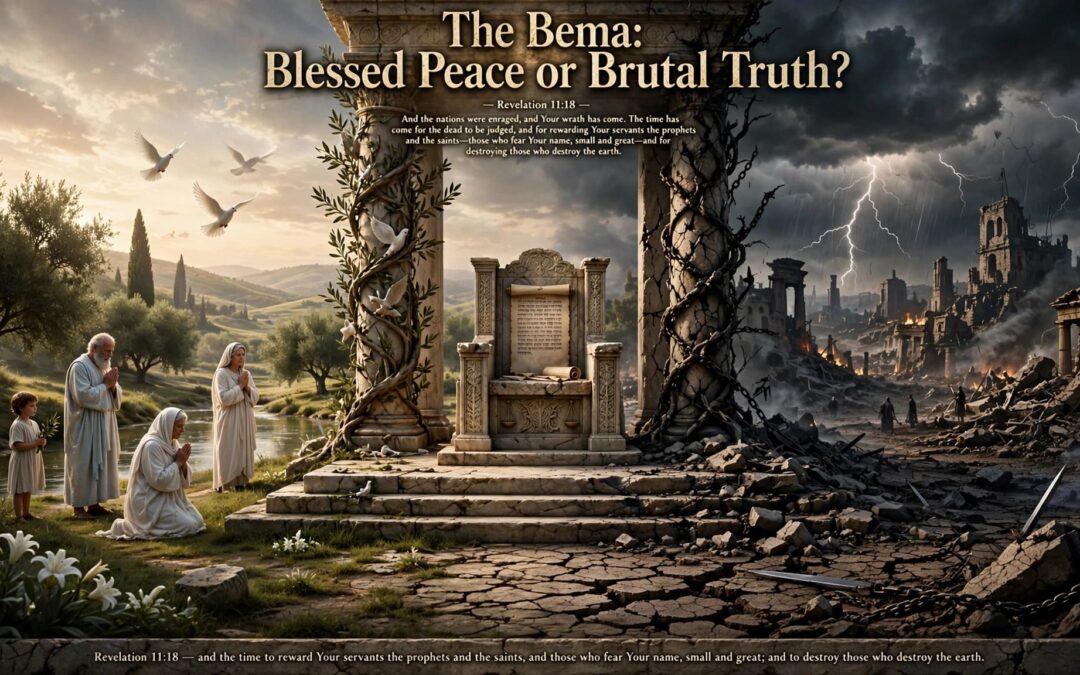

The Bema: Christ’s Judgment of Our Works and Motives
The Judgment Seat of Christ should change how we spend an ordinary Tuesday. A post we type, a person we serve, a truth we defend, and a hidden act nobody sees all matter to Jesus.
The Bema is not a trial where believers find out if they are saved. Christ already paid for sin. It is an evaluation of what believers did with the life, truth, gifts, and opportunities He gave them.
That is sobering, but it is also hopeful. Let’s look carefully at what Scripture says, what it does not say, and why Revelation 11:18 deserves a careful reading.
The Bema in the Bible Is Christ’s Seat of Evaluation
The Greek word translated “judgment seat” is bema (βῆμα). In the first-century world, a bema was a raised platform where an official sat to make public decisions. Acts 18:12-17 uses the word for Gallio’s tribunal in Corinth.
Paul uses bema in 2 Corinthians 5:10: “For we must all appear before the judgment seat of Christ.” Romans 14:10-12 says believers will stand before God’s judgment seat and each person will give an account.
The setting matters. Paul is speaking to people who already belong to Christ. He isn’t telling lost people how to earn salvation. He is reminding saved people that our lives are not meaningless to Jesus.
The Bema happens in Heaven after the rapture and before Christ’s Millennial Reign.

Why the Bema Does Not Condemn Believers for Their Sins
Romans 8:1 says, “There is therefore now no condemnation for those who are in Christ Jesus.” Jesus said in John 5:24 that the person who believes has passed from death to life and does not come into condemnation.
That doesn’t mean sin is no big deal. It means Christ’s sacrifice settled the question of our acceptance before God. We are not saved by a strong record of ministry, good deeds, or clean online debates.
At the Bema, Christ can expose wasted years, selfish motives, and careless work. There can be loss of reward. 1 Corinthians 3:15 even says a person’s work may burn up while “he himself will be saved, but only as through fire.”
Salvation is not hanging by a thread at the Bema. Jesus secured it by His finished work. Accountability still remains, because grace does not make our choices for us.
What Jesus Will Examine When We Give an Account
1 Corinthians 4:5 gives us a picture that should humble every one of us. When the Lord comes, He will bring hidden things into the light and disclose “the purposes of the heart.”
People can see our words, our ministry titles, our posts, and our public good deeds. Jesus sees why we did them. 1 Samuel 16:7 says people look at outward appearance, but the Lord looks at the heart. Hebrews 4:13 says every creature is exposed before Him.

2 Corinthians 5:10 uses agathon (ἀγαθόν), meaning good, in contrast with phaulon (φαῦλον), meaning bad, base, or worthless. The Bema is not a scoreboard that only counts activity.
Jesus will see whether our work was faithful, loving, truthful, and done for Him. A small act of obedience may have more Kingdom value than a loud ministry platform.
Jesus does not only see what came from our hands. He sees what was driving our hearts.
How the Bema Tests Kingdom Work by Quality, Not Quantity
1 Corinthians 3:11-15 gives the clearest picture of tested work. Paul says no one can lay a foundation other than Jesus Christ. Christ is the foundation. Nobody builds a life with God by replacing Him with effort.
Paul then names two kinds of materials: gold, silver, and precious stones, followed by wood, hay, and straw. Fire tests each person’s work and reveals its quality.
The immediate context is ministry and the building of God’s church. Paul had planted, Apollos had watered, and God gave the increase. Still, the principle reaches our service to Christ. He tests what we build, not merely how busy we looked.
Fire Reveals What Will Remain
Gold does not become hay under fire. Straw cannot pretend to be gold when the flames come. The testing reveals what was there all along.
If a person’s work remains, that person receives a reward. If it burns, the person suffers loss, though the believer is saved. This is why the Bema is serious without being a threat of eternal condemnation.

We should not picture the Bema as Jesus looking for reasons to embarrass His people. He is the righteous Judge. He will tell the truth about every work, including the works people praised that had no lasting spiritual substance.
How Motives Turn Religious Activity Into Worthless Work
Jesus warned in Matthew 6:1-6 about doing righteous acts to be seen by people. Public prayer, giving, and spiritual talk can look impressive while feeding a hungry ego.
1 Corinthians 13:1-3 makes the same point. A person can speak with impressive words, give away possessions, and even make great sacrifices, yet have no love. Without love, Paul says, it profits nothing.
Pride, rivalry, fear, and the need to be noticed can turn religious activity into wood, hay, and straw. Love, humility, obedience, and faithfulness are very different materials.
Some of the work that survives the Bema may be work no human being ever noticed. A prayer prayed in a hospital room. A meal brought to a struggling family. A patient conversation with a confused new believer. God saw it all.
Online Bible Arguments Can Waste Kingdom Work
We need to be honest here. Some believers spend hours fighting other believers online about prophetic timelines, Bible translations, spiritual gifts, and interpretations that do not change whether anyone obeys Jesus.
Titus 3:9 tells us to avoid foolish controversies, genealogies, quarrels, and fights about the law because they are unprofitable and worthless. 2 Timothy 2:23-25 says the Lord’s servant must not be quarrelsome, but kind, patient, and able to correct opponents with gentleness.
When Correction Builds Up the Church
Not every disagreement is sinful. Paul confronted false gospels. Jude tells believers to contend for the faith. Serious error can hurt people, so silence is not always love.
The question is simple: does the conversation protect people from falsehood and help them follow Christ? Or are we trying to win, embarrass someone, and collect applause from people who already agree with us?
Romans 14 warns believers not to despise or judge one another over disputable matters. James 1:19-20 says we should be quick to hear, slow to speak, and slow to anger, because human anger does not produce God’s righteousness.
Why Winning Bible Arguments May Not Survive the Fire
1 Corinthians 8:1 says knowledge puffs up, but love builds up. We can know a verse, a Greek word, or a doctrinal system and still use it like a weapon.
A comment thread can create heat without light. It can leave people angry, divided, and less willing to hear Scripture. If nobody is helped to love Christ, serve others, repent, or understand truth, what did all that effort produce?
Only Christ sees the heart, but arguments fueled by pride and contempt may be the very wood, hay, and straw exposed at the Bema. Before hitting “post,” we should ask whether our words are true, necessary, loving, and useful. Sometimes correction is needed. Other times, peace is wiser.
When Does the Bema Take Place?
1 Corinthians 4:5 gives an important marker. Paul says not to judge before the time, “until the Lord comes.” At His coming, Jesus will reveal hidden things and the intentions of hearts, then each person will receive praise from God.
The Bema happens after the rapture, while we are with Christ, and before His Millennial Reign, connecting the reward of believers with end-time events before Revelation 20.
Scripture clearly promises the Bema. It does not plainly give every event a date and sequence. We all can hold a view about timing without pretending every faithful Christian must agree with every detail.
Revelation 11:18 and the Time of Reward
Revelation 11 records the sounding of the seventh trumpet. The twenty-four elders worship because God has taken His great power and begun to reign. Then Revelation 11:18 says the nations raged, God’s wrath came, and the appointed time arrived.
The Greek phrase is: ho kairos ton nekron krithenai kai dounai ton misthon tois doulois sou.
It speaks of “the time” for the dead to be judged and for God to give reward to His servants, the prophets, the saints, and those who fear His name, both small and great.
The Greek Words in Revelation 11:18
Kairos (καιρός) means an appointed time or season. It is not merely a moment on a clock. God has a set time for His purposes.
Krithenai (κριθῆναι) means “to be judged.” Dounai (δοῦναι) means “to give.” Misthos (μισθός) means reward, wages, or payment for service.
The phrase tois doulois sou means “to your servants.” John then identifies prophets, saints, and those who fear God’s name. Reward for God’s servants is plainly in the verse.
Why Revelation 11:18 Supports Timing but Does Not Prove It Alone
There is a strong reason we connect Revelation 11:18 with the Bema. It places the reward of God’s servants in an end-time judgment scene, and it appears before the Great White Throne scene of Revelation 20.
Still, Revelation 11:18 does not use the word bema. It also speaks about judging the dead and destroying those who destroy the earth. The verse may describe a broader gathering of end-time judgments.
We can say Revelation 11:18 supports the idea of a coming reward for God’s servants. We cannot honestly say this verse alone proves the full timing of the Bema. Scripture is clear about reward and judgment. The exact sequence takes more careful interpretation.
The Bema and the Great White Throne Are Different Judgments
The Bema passages speak to believers appearing before Christ, giving an account, and receiving what is due for their work. Romans 14 is written to brothers and sisters. 2 Corinthians 5 is written to Christians reconciled to God.
Revelation 20:11-15 shows the Great White Throne. The dead, great and small, stand before the throne. Books are opened. Another book, the book of life, is opened. Those not found in the book of life are thrown into the lake of fire.
Reward Is Not Final Condemnation
The common distinction is based on context and outcome, not only the words “seat” and “throne.” At the Bema, believers face evaluation, reward, or loss of reward. At the Great White Throne, the scene ends with final condemnation for those outside the book of life.
Christians differ about end-time timelines, but this contrast is hard to miss. 1 Corinthians 3 says the believer can suffer loss and still be saved. Revelation 20 describes the lake of fire.
Grace should never become an excuse for careless sin. The person saved by Christ should want to live in a way that pleases Christ.
Faithful Work Will Endure
The Bema brings our daily choices into the light. Jesus cares about the truth we speak, the people we serve, the motives we hide, and the time we spend arguing online.
We should pursue work built on love, obedience, humility, and truth. When correction is needed, we can give it with gentleness. When Scripture allows freedom, we can choose peace.
The Bema is a sober reminder of accountability, but it is not a threat to salvation Christ has already secured. Faithful work that people overlook is never overlooked by Him.

